English
 Español
 Português
 Русский
 Deutsch
 Francés
 العربية
 한국어
한국어
 Türk
Türk
 日本語
日本語

What is the working principle of a fully automatic molecular sieve filling machine in a double-glass production line?
In channel-type insulated glass production lines, the desiccant filling step is easily overlooked—until issues like haze, fogging, or edge seal problems arise. The fully automatic molecular sieve filling machine (also called a molecular sieve filler) is designed to make this step consistent, clean, and repeatable by automating the drilling, dust-free filling, and sealing of aluminum spacers. For many factories, upgrading to a fully automatic filler is one of the fastest and most practical ways to stabilize long-term IGU quality and reduce operator dependence in daily production.
How the Fully Automatic Molecular Sieve Filler Works in Insulated Glass Production Lines
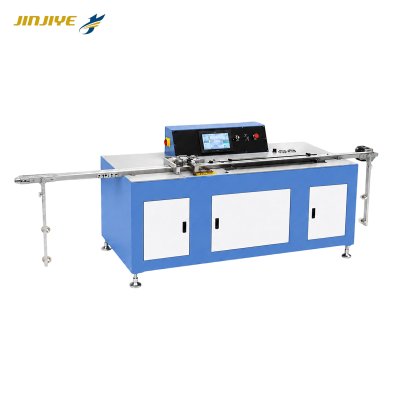
In most layouts, the fully automatic molecular sieve filler (also called a molecular sieve filling machine) is positioned upstream of the aluminum frame bending machine. The goal is simple: to fill the spacer cavity with molecular sieve using a closed, controlled airflow, keeping the granules intact and keeping dust out of the IGU cavity.
Typical Closed-Loop Process
1. Automatic Drilling: Spacers are clamped and drilled in consistent positions, eliminating manual errors.
2. Enclosed Hopper Feeding: Molecular sieves are stored and transported within a closed system to minimize exposure and contamination.
3. Airflow-Assisted Filling: Precisely distributed airflow gently conveys the molecular sieves, supporting low-dust, low-breakage transfer.
4. Metered Filling: Filling time/pressure (and in some configurations, quantity logic) controls the fill level for spacers of different widths.
5. Detection and Stop: Sensors stop filling when the target level/quantity is reached to prevent overfilling and spilling.
6. Automatic Sealing: Holes are sealed so that the frame can be moved directly to bending and assembly.
A practical way to visualize it is:
Spacer in → Drill → Closed airflow fill → Detect → Seal → Spacer out
Characteristics of the Daily Reliability of Modern Molecular Sieve Filling Machines
A molecular sieve filling machine ready for production is more than just a hopper and a nozzle. On the workshop floor, the most important components usually include:
• Rigid clamping: a stable drill for repeatable hole placement
• Enclosed desiccant hopper (optional large-capacity feed for longer run times)
• Air duct distribution and filling nozzles designed to minimize particle impact
• Level/quantity logic (depending on configuration, using time/level/other sensor methods)
• Sealing unit to prevent leaks and prepare spacers for downstream equipment
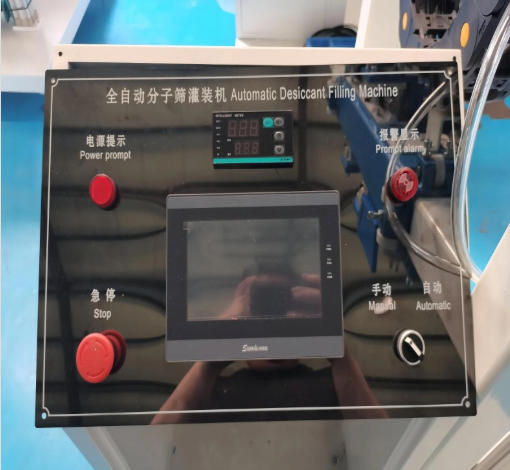
• PLC and HMI for recipes, alarms, and quick changeovers
• Safety guards and interlocks to support stable operation
For buyers comparing insulating glass equipment, this is where 'automation' becomes real: less manual handling, fewer minor errors, and fewer quality surprises.
Reasons why the factory upgraded from manual filling to fully automatic filling machines:
Manual and semi-automatic methods usually bring two avoidable risks: dust and inconsistent filling. Dust may migrate into the chamber and later appear as haze; inconsistent filling may gradually weaken moisture resistance over time.
Item | Manual filling | Semi-automatic | Fully automatic |
Dust control | High spill risk | Reduced, still exposed | Very low with closed filling |
Bead breakage risk | High | Medium | Low with gentle airflow |
Repeatability | Operator-dependent | Improved | PLC-controlled consistency |
Labor dependence | High | Medium | Low (supervision-focused) |
Line throughput | Low | Medium | High; dual-head optional |
A well-configured fully automatic molecular sieve filling machine helps preserve adsorption capacity—an important detail for long-term IGU clarity—by minimizing particle abrasion and fines.
Pre-purchase Configuration Checkpoints
Different models of fully automatic molecular sieve filling machines are designed for varying output levels and frame ranges. Before finalizing a solution, it’s best to align the machine configuration with your actual production mix:
• Spacer range: Ensure compatibility with the width of your aluminum spacers as well as any special profiles used in your sealed insulating glass.
• Desiccant specifications: Match the feeding system to your molecular sieve size/grade.
• Adjustable fill height: Recipe-based settings help you switch between different spacer sizes without trial and error.
• Utilities: Ensure the workshop has stable compressed air and the correct power supply.
• Single-head vs. dual-head filling: Choose based on daily output and shift schedules.
• Material feeding options: Larger or more sealed hoppers reduce downtime and help manage moisture exposure.
• Integration: Confirm coordination with the frame bending machine and downstream assembly.
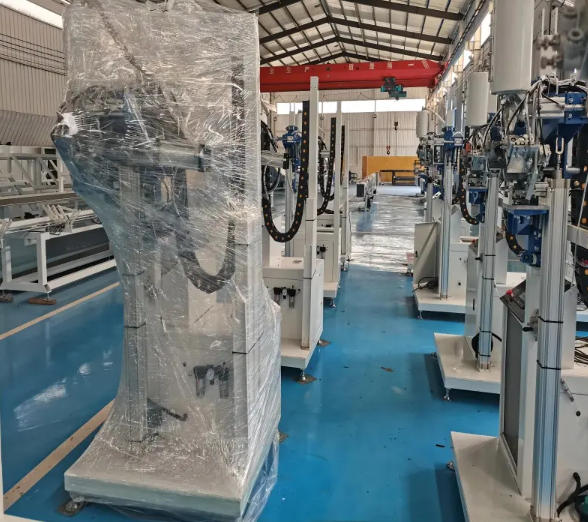
The molecular sieve filling machine should feel like part of the production line—not an isolated workstation that forces workarounds.
ROI list of fully automatic filling machine upgrades
When a factory switches from manual filling to fully automatic filling machines, the return on investment often comes from a combination of the following:
• Reduced scrap due to dust contamination and moisture-related issues
• Reduced rework due to inconsistent drilling, fill levels, or seals
• Reduced labor intensity, especially during peak production periods
• More stable cycle time, reducing bottlenecks upstream of the bending machine
If you track the "before vs. after" metrics – the cause of scrap, the cycle time per frame, and the operating staff per shift – you can quantify the impact that the fully automatic zeolite filling machine has to make sense for procurement and production management.
Commissioning practices to protect quality from day one
For factories transitioning to fully automatic molecular sieve filling machines, the smoothest start-up typically follows a few essential steps:
• Start by running a pilot portfolio to lock in stable recipes.
• Operators are trained on hopper loading, recipe selection, and alarm handling.
• Record the die change steps for different spacer widths.
• Maintain discipline in desiccant handling: sealed storage, clean loading, regular seal checks.
These steps help your insulating glass equipment investment deliver consistent results, not "good weeks" and "bad weeks."
Frequently Asked Questions
How to keep the automatic molecular sieve filling machine dust-free? Closed hopper and controlled airflow reduce particle breakage and spillage. Inspection logic prevents overfilling, and sealing ensures that spacers remain clean when moved to the next station.
Will the molecular sieve filling machine work with my spacer size? Most configurations cover a range of common aluminum spacers used in fluted aluminum insulating glass. Final confirmation should be based on your spacer width, height, and profile list.
Do molecular sieves absorb moisture while waiting in the machine? With closed feeds and good storage discipline, moisture absorption is reduced. Keeping spare materials sealed and minimizing exposure is key.
What utilities are typically required for a fully automatic filling machine? Compressed air and proper power supply are standard requirements; The exact specifications depend on the chosen configuration.
Next steps
The automatic zeolite filling machine is a small but high-impact upgrade: cleaner cavities, more consistent spacer filling, and a more stable production rhythm. If you are evaluating a new molecular sieve filler as part of an upgrade to your insulating glass equipment, we can help you match the right configuration – single/double head – single / double head and feed option and recipe control based on your spacer range and daily output.