English
 Español
 Português
 Русский
 Deutsch
 Francés
 العربية
 한국어
한국어
 Türk
Türk
 日本語
日本語

Do you know the working principle and applications of a glass cutter?
A glass cutting machine is the first “make-or-break” step in most flat-glass factories. When the cutting stage is stable, everything downstream—edging, washing, tempering, lamination—runs smoother. When it isn’t, scrap rises, edge defects appear, and operators spend the day chasing inconsistencies. This guide explains the glass cutting machine working principle in plain terms, shows where CNC scoring fits compared with waterjet and laser, and lists the practical configuration and maintenance points buyers should verify before purchasing a glass cutting machine line.
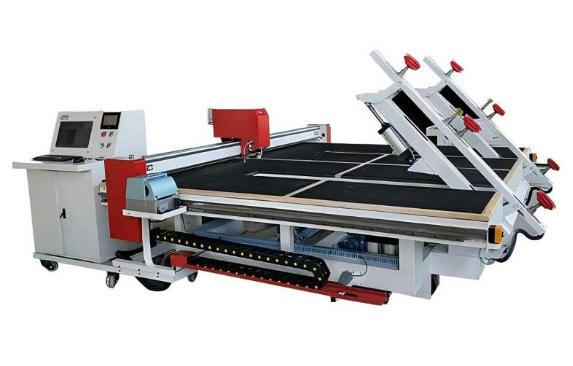
What a glass cutting machine actually does
In industrial production, a glass cutting machine does not “saw” through the sheet. Instead, it relies on the physics of glass scoring and breaking:

For procurement and engineering teams, a few terms matter:
Glass cutting machine working principle from loading to finished blanks
A modern glass cutting machine typically follows a repeatable workflow. While the details vary by automation level, the core logic stays the same.
1. Loading and positioning
Sheets are loaded by vacuum lifter or tilt-bar onto an air-float or vacuum table. Sensors (edge sensors or alignment lasers) reference the sheet to the machine coordinate system so the cut program matches the actual glass position.
2. CNC scoring
The cutting head moves along X–Y axes, and the controller coordinates the scoring parameters:
In many standard architectural and automotive applications, a well-configured CNC glass cutting machine can target dimensional accuracy around ±0.2 mm, assuming correct setup, stable handling, and routine calibration.
3. Separation / breaking
After scoring, the glass cutting machine applies controlled force—break bars, localized pressure points, or air jets from below—to open the score line. The goal is a clean break that minimizes chips and protects edge strength for downstream processing.
4. Transfer to downstream processes
Finished blanks move to edge grinding/polishing, washing, tempering, or lamination. In a well-planned layout, the glass cutting machine becomes the “traffic controller” that keeps the entire line fed without bottlenecks.
CNC vs waterjet vs laser vs manual methods
Different technologies exist, but they serve different production realities. For most plants, the glass cutting machine based on CNC scoring remains the throughput leader.
| Best Fit (Geometry & Thickness) | Edge & Thermal Impact | Speed & Operating Cost | Typical Use | |
|---|---|---|---|---|
| CNC scoring glass cutting machine | Common flat glass (often 2–19 mm), high-volume shapes | Good; usually followed by light seaming/edging | Very fast; low consumables | Architectural, automotive, furniture |
| Waterjet glass cutting (abrasive) | Thick, laminated, or complex contours | Excellent; no heat-affected zone | Slower; higher consumables | Special shapes, small batches |
| Laser cutting | Mainly thin or specialty glass | Fine, but HAZ risk depending on process | Higher capex; medium speed | Electronics, displays |
| Manual scoring & breaking | Low volume, limited precision | Operator-dependent | Low equipment cost; high labor | Small shops, rework |
In practice, plants often keep a primary CNC glass cutting machine for daily production and use waterjet glass cutting or laser for “exception” parts where scoring cannot guarantee yield.
Key components that determine yield and edge quality
When comparing an industrial glass cutting machine, focus on the parts that influence consistency—not just the brochure speed.
Before ordering, confirm your sizing and integration requirements:
If you’re planning a complete line, you can review typical layouts on our product page: glass cutting line solutions.
Application-focused configuration notes
Architectural glass
A glass cutting machine for architectural work typically prioritizes large sheets, high nesting yield, and clean separation to reduce edging time. Common thickness ranges fall roughly within 3–19 mm depending on the project.
Automotive glass
Automotive production values repeatability and traceability. A CNC glass cutting machine paired with automatic labeling (including QR options) helps reduce mix-ups and supports tighter process control.
Furniture and mirrors
Furniture and mirror buyers often care most about cosmetic edge results after edging and polishing. For this segment, stable scoring, clean break behavior, and fast program changeovers improve both throughput and finish quality.
Electronics and optics
Plants handling thin or specialty glass may mix a smaller glass cutting machine for scoring with laser or waterjet for specific contours and materials.
Maintenance and troubleshooting that prevents scrap
A glass cutting machine is only “accurate” when it is clean, calibrated, and running with healthy consumables.
Daily checks
Weekly checks
Monthly checks
Common defect mapping for a glass cutting machine:
| Defect | Likely Cause | Fast Fix |
|---|---|---|
| Edge chipping | Worn wheel or incorrect pressure | Replace wheel; reset pressure |
| Break line wanders | Score too shallow/deep or wrong break force | Tune scoring + breaking settings |
| Surface scratches | Contamination on table/rollers | Clean supports; improve handling |
FAQ for selecting an industrial glass cutting machine
What thickness can a CNC scoring system handle?
Most scoring-based glass cutting machine setups cover about 2–19 mm depending on model, glass type, and wheel configuration.
What accuracy is realistic?
With correct handling and regular calibration, many users target around ±0.2 mm for common architectural and automotive parts on a CNC glass cutting machine.