Automated glass cutting and an insulating glass production line have to solve a practical problem every day: keep dust away from coated glass edges without slowing the line. In real production scenarios, dust can appear as cutting debris, film dust, or grinding layer dust. If it travels downstream, it can complicate the critical next steps of washing and insulating glass assembly.
Identifying Dust Sources on the Production Line
A typical insulating glass production line functions as a connected flow. The key to maintaining quality is identifying where dust is generated and where it can be captured before it impacts the final unit.
Common Dust Generation Flow:
•IG unit preparation and assembly (butyl extruder + spacer bending + desiccant filling) Here is a breakdown of the critical points:
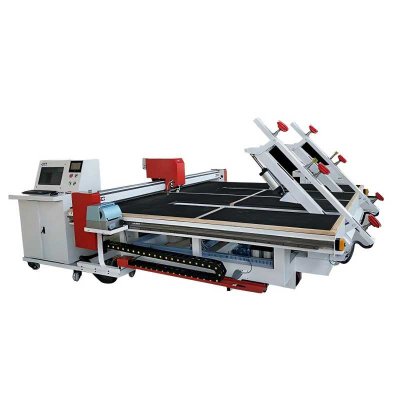
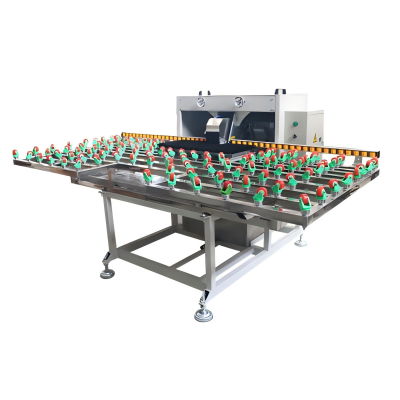
•CNC glass cutting machine (automated glass cutting): This stage creates debris during the cutting and breaking process. It is an early-stage dust source that must not be carried toward the coated edge-processing station. •Glass film removing machine: This is a direct dust-generation step because the film removal process uses a grinding wheel. To combat this, our Low-E glass edge removing machines are equipped with an automatic suction device to capture membrane dust, and specific models feature an absorption device for grinding layer dust.
•Vertical glass washing machines: These units are the final defense, removing any remaining dust, oil, and water to prepare cleaner glass for assembly.
Features That Ensure Stability
On a high-efficiency insulating glass production line, the advantage of an automated Low-E glass edge removing machine is consistency. With our equipment, operators simply input the required film removal size, and the system runs with controlled motion and integrated dust capture.
Key capabilities of our edge deletion technology include:
•Simplified Input: On certain models, there is no need to enter full glass dimensions—just the required film removal size.
•Complex Shapes: Unequal-width film removal can be completed at one time, including processing for special-shaped glass and point hole edges.
•Precision Control: The grinding wheel is driven by a servo motor, allowing for precise speed control adaptable to different film layers.
•Maintenance Automation: The grinding wheel is regularly trimmed by a diamond pen (mechanically trimmed on some models) to maintain optimal film removal effectiveness.
•Seamless Integration: Our units can automatically link with any brand of vertical hollow production line to realize continuous flow operation.
Throughput Controls for High-Speed Lines
For manufacturers prioritizing speed on automated glass cutting lines, several functions in our vertical edge deletion equipment are designed to keep pace without sacrificing quality:
•Advanced Control: We utilize a Full servo convey system and a Germany Siemens control system (or equivalent high-standard systems) for fully automatic operation.
•Asynchronous Operation: The input and output sections can run asynchronously, significantly improving overall productivity.
•Adjustable Speeds: Stripping speed is fully adjustable to match different film types and the expected finish quality.
•High Accuracy: Equipped with six servo motor controls, the system offers linearly adjustable sizing to guarantee higher accuracy for arcs and complex shapes.
•Source Capture: A built-in dust suction device mitigates pollution right at the source.
Technical Parameters for Selection
When matching a Low-E glass edge removing machine to your insulating glass production line, these parameters help define the right fit for your facility:
•Width of film removal: 8–300 mm (depending on model)
•Working speed: 25–45 m/min (depending on model)
•Power consumption: 3AC380V 50Hz 8 kW
•Air supply requirements: 0.6 MPa, 1.5 m³/min
•Processing size: From 300×300 mm up to 2400×3600 mm, with large size customization available.
Additional Performance Specs:
•Input power: ~8.9 kW
•Max glass size: 2500×4000 mm
•Glass thickness: 3–18 mm
•Removing width: 10–150 mm
•Removing speed: 0–30 m/min adjustabl
 English
 Español
 Português
 Русский
 Deutsch
 Francés
 العربية
 한국어
한국어
 Türk
Türk
 日本語
日本語