English
 Español
 Português
 Русский
 Deutsch
 Francés
 العربية
 한국어
한국어
 Türk
Türk
 日本語
日本語

What Is Included in a CNC Glass Cutting Line?
Watch a glass cutting line demonstration through to the finished pieces. The cutting head completes its route, the sheet moves to the breakout area, and the individual panes are separated and collected.
Now ask a simple question: who does each part?
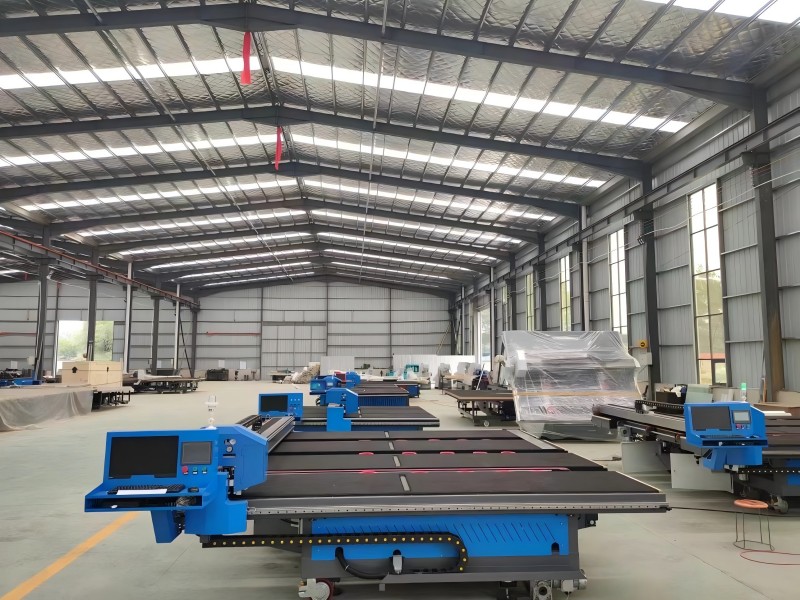
A CNC glass cutting line commonly brings together glass loading, CNC scoring and breakout. These functions may be arranged across separate machines or combined in a compact system. The equipment layout and the amount of operator involvement depend on the configuration you order.
Glass Loading Starts at the Rack
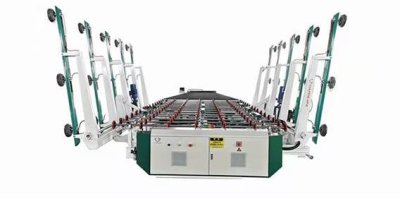
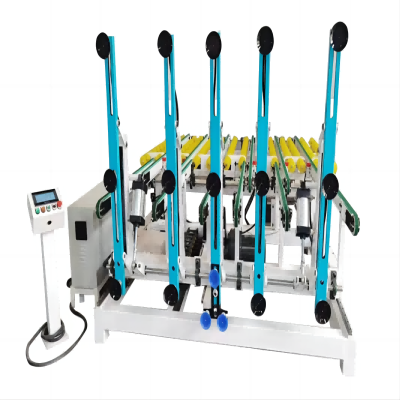
The loading section brings a stock sheet from its storage position to the cutting area. An automatic loader may use vacuum suction cups to pick up the sheet and transfer it onto the table.
For a buyer, the useful details include the permitted sheet dimensions, thickness range, loading capacity and rack arrangement.
Ask which rack positions the loader can serve. If your production regularly changes between glass types or thicknesses, discuss how those changes will be handled. A loading arrangement demonstrated with one rack may need a different configuration for your workshop.
Follow the complete loading cycle until the sheet is positioned and ready for scoring.
The CNC Table Scores the Cutting Layout
For conventional wheel cutting of annealed, untempered float glass, the cutting head follows a programmed layout and scores the surface. The individual pieces are then separated during breakout.
The CNC table controls the cutting path. Depending on the selected machine and software, the system may also provide sheet positioning, layout optimisation and shape-cutting functions.
When comparing equipment, check the glass types and thicknesses it is designed to process. Cutting-wheel selection and scoring settings need to suit the material.
Finished dimensions and edge condition should be checked after breakout. A score line on the table gives you only part of the result.
Already tempered glass cannot be cut to a new size. Laminated glass requires equipment and processing steps suited to its layered construction.
The Breakout Section Needs a Clear Description
At the breakout stage, the scored sheet is separated into the required panes.
This is where quotations can differ substantially. One system may use an operator-assisted breaking table. Another may automate selected breaking operations while leaving some separation and collection tasks to an operator.
An air-cushion table can assist glass movement, and pneumatic breaking equipment can assist separation. Their presence alone does not establish how much of the work is automatic.
Ask the supplier to describe the breakout process for your usual jobs. Include small panes, narrow strips or shapes if they are part of your order mix.
You should know who separates the pieces, removes the offcuts and clears the table for the next sheet.
Check the Transfers Between Machines
The loader, cutting table and breakout section need to work together within the available space.
Review the direction of glass travel, transfer arrangements, operator positions and the route used to collect finished panes. Allow room for glass racks and maintenance access as well as the machines themselves.
A useful layout drawing shows how glass enters and leaves each stage. It should also identify the connection to the next production operation.
For an existing factory, share a workshop plan before the configuration is finalised. Doorways, columns and established handling routes can affect where the line fits.
Get the Equipment Scope in Writing
Before comparing prices, ask for a clear list of what each quotation includes:
The loading equipment and rack positions it serves.
The CNC cutting table, control system and software functions.
The breakout equipment and remaining operator tasks.
Optional functions such as labelling or Low-E edge deletion.
Installation, commissioning, training and utility requirements.
A description such as “automatic glass cutting line” leaves room for different equipment scopes. A written configuration makes the comparison much clearer.
You can review JINJIYE’s automatic glass cutting system as a starting point, then confirm the included machines and optional functions for your project.
Discuss Your Glass Cutting Requirements with JINJIYE
To discuss a suitable configuration, send JINJIYE your stock-sheet sizes, glass types, thickness range, typical finished-piece dimensions and production target.
Include your available workshop space and the level of automation you require.
These details help us review the loading, cutting and breakout arrangement around the work your factory actually handles.
Contact JINJIYE to Discuss Your Glass Cutting Line