English
 Español
 Português
 Русский
 Deutsch
 Francés
 العربية
 한국어
한국어
 Türk
Türk
 日本語
日本語

How to Choose a Glass Vacuum Lifter: Capacity Is Not Enough
How to Choose the Right Glass Vacuum Lifter for IGU Production
A glass vacuum lifter should not be selected by maximum load capacity alone.
Start with the heaviest finished glass unit, then check its dimensions, centre of gravity, surface condition and required movement. A short but heavy panel and a long, narrow IGU may need different suction-pad arrangements even when their total weight is similar.
The lifting environment matters too. Moving glass between two machines inside a factory is different from rotating a large panel, loading a rack or installing glass outdoors.
Begin with the Actual Finished Glass
The first number a supplier needs is not the glass length. It is the verified weight of the complete load.
For an early planning estimate, ordinary glass is often calculated at approximately 2.5 kg per square metre for every millimetre of glass thickness. With an IGU, add the thickness of every glass pane, but not the width of the air or gas cavity.
This remains an estimate. Laminated glass interlayers, frames, attachments and other components can add weight. Use the confirmed product specification before selecting the safe working load.
Do not choose a lifter whose published capacity is almost identical to the heaviest panel. The supplier should review the complete application and confirm an appropriate model and configuration.
The UK Health and Safety Executive advises that vacuum lifting attachments should be tested as a complete assembly on the material they will actually lift. That is more meaningful than testing only a suction cup on ideal laboratory glass.
Panel Dimensions Affect the Suction-Pad Layout
Weight alone does not describe how stable the glass will be during movement.
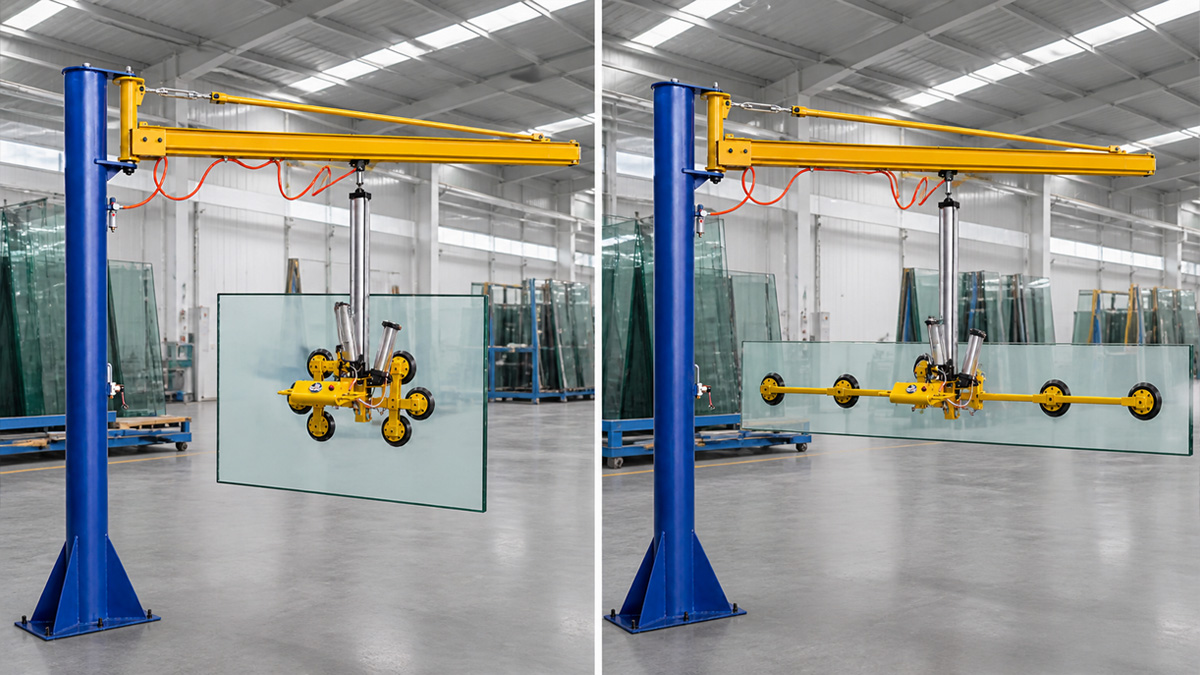
A long panel can flex or peel away from the outer suction pads if the frame is too narrow. A small panel may not cover every pad on a large lifting frame. Irregular glass may require individual pads to be isolated or repositioned.
Before requesting a quotation, provide:
Minimum, typical and maximum glass dimensions
Total glass weight
Double- or triple-glazed construction
Horizontal or vertical starting position
Required lifting height
Required rotation and tilting
Distance between pickup and placement points
The supplier should show where the pads will contact your largest and smallest glass units.
The number of suction cups should not be selected through a simple “kilograms per cup” calculation. Pad diameter, spacing, vacuum level, glass orientation and frame design all affect the complete lifting system.
Confirm That the Surface Can Hold a Reliable Vacuum
Vacuum pads need a clean, smooth and sufficiently airtight contact area.
Dust, water, oil, packaging film and damaged rubber seals can cause leakage. Some protective films may appear firmly attached to the glass but can separate from the panel under load.
Wirth’s current OKTOPUS glass-lifter guidance states that its suction areas must be clean, air-impermeable and free of protective foil. Requirements vary between machines, so confirm the condition for the exact lifter being purchased.
Coated, textured, curved or patterned glass requires particular care. Do not assume a suction pad suitable for flat float glass can safely lift every decorative or coated product.
Send the supplier a sample or arrange a lifting test when the surface differs from normal flat glass.
Look Beyond the Vacuum Pump
A pump creates the vacuum, but the safety of the system also depends on what happens after pressure begins to fall.
Depending on the application and local requirements, important features may include:
Independent vacuum circuits
Vacuum reservoir
Clearly visible pressure gauge
Audible and visual low-vacuum warnings
Automatic pump restart
Battery-condition indicator
Non-return valves
Protected hoses and connections
A dual-circuit vacuum lifter provides additional redundancy when the machine and application are designed for it. However, two rows of suction cups should not automatically be described as two independent circuits. The pipework, valves, reservoirs and monitoring system must be checked.
The HSE also recommends that powered lifting attachments provide clear vacuum indication and suitable warnings. Always follow the equipment manufacturer’s instructions and the safety requirements that apply in the country of use.
Decide Which Movements the Operator Actually Needs
Rotation and tilting can save considerable manual handling, but they should match the real workflow.
A factory may need to:
Lift glass vertically from a rack
Rotate it through 90 degrees
Place it horizontally on a processing table
Turn the panel for inspection
Transfer a finished IGU to an unloading rack
If the operator regularly moves between vertical and horizontal positions, a glass lifter with rotation and tilting is more practical than a basic lifting frame.
Check whether these movements are manual, pneumatic or electric. Also confirm how the glass is locked during rotation and how much clearance the equipment needs.
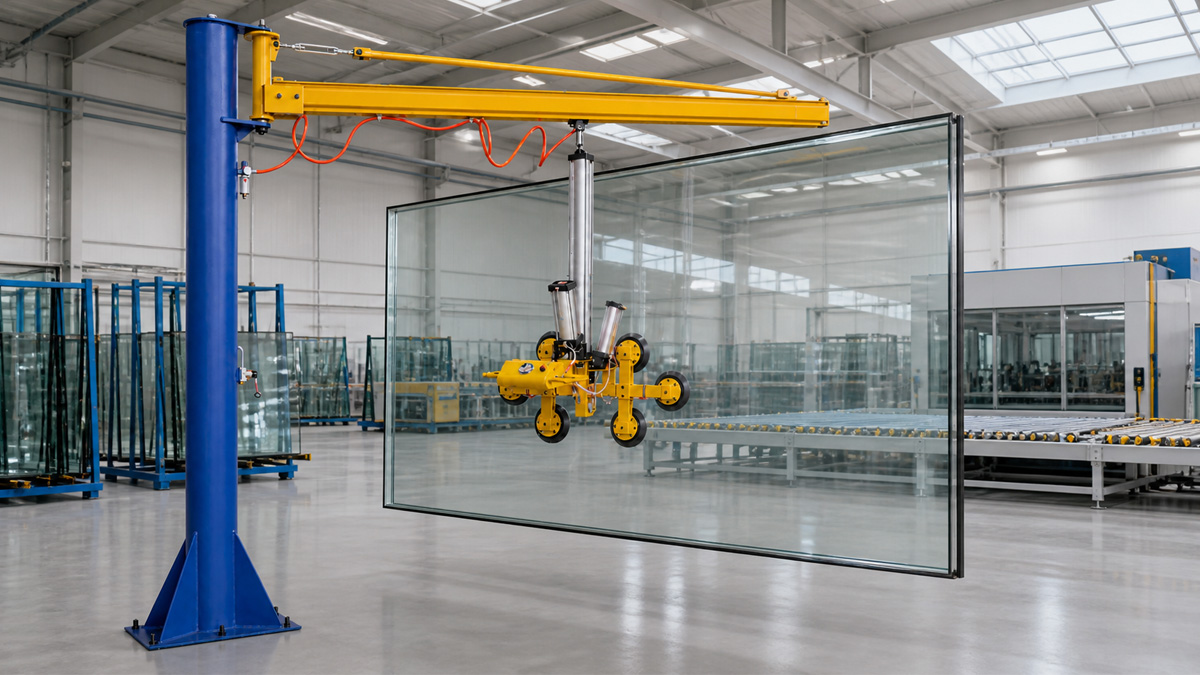
The JINJIYE vacuum suction cup glass lifting crane offers configurable lifting, rotation and suction-cup arrangements. The final specification should be selected according to the customer’s glass rather than copied from a standard product image.
Choose Between a Fixed Lifter and a Mobile Machine
A column-mounted or jib-crane glass lifter works well when the pickup and placement points stay within a defined factory area. It can be installed beside a cutting table, washing machine, laminating line or finished-glass rack.
A mobile multifunction insulating glass vacuum lifter is more suitable when the operator must travel between several stations.
Neither design is automatically better.
A fixed system usually provides a predictable working path, while a mobile machine offers greater flexibility. Compare floor condition, aisle width, turning radius, door clearance and charging or air-supply requirements.
Factories planning a larger handling upgrade can also review the complete glass loading and unloading equipment range.
Test the Most Difficult Panel Before Purchase
A supplier demonstration using a small, clean sheet of float glass does not prove that the lifter is suitable for your production.
Test the heaviest, largest and most awkward regular panel. During the test, check:
Time required to reach the working vacuum
Pressure stability while stationary
Warning and backup functions
Pad contact on every area
Glass stability during acceleration and stopping
Rotation and tilt control
Accuracy when placing glass
Operator visibility and access
The travel path should remain clear, and people must not stand below or within the potential fall zone of a suspended load.
A Short Pre-Shift Check Matters
Even a correctly selected lifter can become unsafe when pads, hoses or warning devices are damaged.
Before the first lift, the trained operator should check the machine in accordance with its manual. Typical inspection points include:
Suction pads are clean, dry and undamaged
Hoses and connections show no visible damage
Vacuum gauges and warnings work
Battery or air supply is ready
Rotation and locking mechanisms operate correctly
The glass contact surface is clean
The load matches the approved application
The travel route and placement area are clear
Any abnormal vacuum loss should be investigated before production continues.
Frequently Asked Questions
What capacity glass vacuum lifter do I need?
Begin with the verified weight of the heaviest finished unit, then provide the glass dimensions, orientation and required movements to the manufacturer. Do not select equipment from weight alone.
Can a vacuum lifter handle insulating glass units?
Yes, when the lifter is designed and tested for the unit’s weight, dimensions, surface and handling direction. Finished IGUs may be heavier and more flexible than a single pane.
Can the same suction pads lift Low-E or coated glass?
Possibly, but it must be confirmed. The coating, surface texture, protective film and approved contact side can affect pad sealing or surface protection.
Is a dual vacuum circuit necessary?
It may be required or strongly preferred for certain applications, particularly higher-risk or construction-site lifting. The correct design depends on the task and applicable safety requirements.
How often should suction pads be checked?
Operators should inspect them before use and follow the manufacturer’s maintenance schedule. Damaged, hardened or contaminated pads should not remain in service.
Select the Lifter Around the Glass and the Workflow
The best glass vacuum lifter is not necessarily the model with the largest number printed in its specifications.
It is the machine that can safely control your actual glass sizes, maintain a reliable vacuum on the real surface and place each panel where the next production step requires it.
Send JINJIYE the glass construction, minimum and maximum dimensions, verified weight, pickup position, placement position and workshop layout. This allows the lifting frame, suction pads and movement functions to be configured around the job.