English
 Español
 Português
 Русский
 Deutsch
 Francés
 العربية
 한국어
 Türk
 日本語

IGU Sealing Robots for Stepped Glass: Start with the Edge Drawing
In a stepped IGU, the panes don't finish at the same edge. One projects beyond another, even though both may be ordinary rectangles. The offset becomes clear in a section through the edge. That edge changes the job for the sealing machine.
There may be plenty of room for the unit inside the machine. Underneath it is a different matter. If the larger pane reaches the conveyor and the smaller one doesn't, that smaller pane needs support at its own level. The nozzle also needs room to work at the recessed joint. Any extra equipment required for that construction needs to be priced with the machine. If stepped insulating glass is on your order list, take the edge drawings into the equipment discussion early. “Stepped glass available” needs a little more explanation before you can put those jobs into production.
Which edges have a step?
Start with a front view and a section through each different edge. A note saying “stepped unit” won't show whether the larger pane projects on one side or all four. Show it as it will enter the sealer, with the larger pane clearly identified. With a top-only step, the extra glass is above the smaller pane; the two bottom edges still line up. Now compare that with a unit where the smaller pane is inset on every side. Both are stepped units. Their lower edges arrive at the conveyor quite differently.
A dimension for the finished unit leaves too much to guess. Each pane has its own width, height and thickness, but those numbers still leave a question: where does it sit in the assembled unit? An edge section answers that by showing the spacer and the overhang together. On a triple-glazed unit, the middle pane belongs in that view too, so nobody has to guess whether its edge is flush or set back. Mark the edge that will run along the conveyor, too. The bottom of the installed window and the bottom during manufacture aren't necessarily the same. Any change in orientation needs to suit the proposed equipment and the glass construction.
The smaller pane still needs support
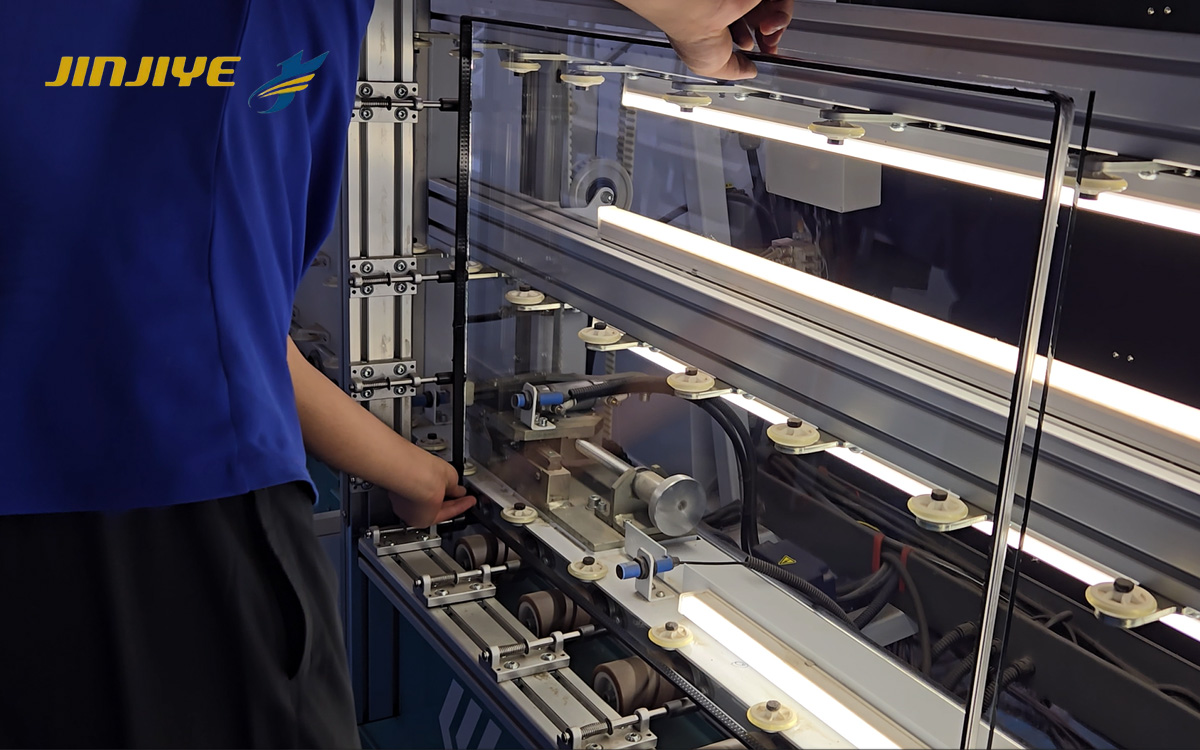
At a bottom step, the conveyor may carry the larger pane while passing below the smaller pane's edge. That leaves the smaller pane without direct support from the conveyor. Depending on the unit and spacer construction, the smaller pane can sink or tip under its own weight.
That has implications beyond the sealing head. On an insulating glass production line, the unit has to leave the press, cross the transfer section and enter the sealer. A support shown inside one machine doesn't explain what happens between machines. Follow the bottom edge through that route on the proposed layout. Where does the smaller pane receive support? How does it transfer to the next section? The supplier's answer should cover your actual bottom step and pane arrangement.
The step isn't the sealing depth
There are two different measurements to discuss here. One describes how far one glass edge projects past another. The other concerns the joint that the secondary sealant has to fill around the spacer. A larger glass overhang doesn't, by itself, tell you the required sealant depth. The edge section needs to show both. Otherwise, “we can handle that step” can leave the sealing work surprisingly vague.
For the robot, reaching the joint and dispensing into it are related but separate tasks. The nozzle needs an approach that suits the glass edges, and its movement and material delivery have to suit the specified joint.
Corners are worth including in the discussion. A straight section of sealant won't show what happens where one stepped edge meets another. Keep the approved joint detail beside the sample when reviewing the result, including any finishing the operator has to do. The equipment needs to accommodate that detail. Reducing the specified joint just to make a machine easier to run would change the product you're trying to manufacture.
What does the stepped-glass option cover?
JINJIYE lists stepped-glass processing as an optional configuration on its automatic CNC insulating glass sealing robot. That makes the project drawing especially useful: it gives the supplier a specific construction to assess, rather than a general request for a machine that “does steps.” A quotation for your work should identify the pane arrangements and step dimensions it covers, including the bottom edge. If a particular job needs extra support, a different setup or operator finishing, you'll want that understood while comparing the offers.
The same applies when only some of your orders are stepped. There may be a setup change between those jobs and ordinary flush-edge units. Find out what the operator changes and whether any parts have to be fitted or removed. A short run of each construction will reveal more about that changeover than a video of one unit travelling through the machine.