English
 Español
 Português
 Русский
 Deutsch
 Francés
 العربية
 한국어
한국어
 Türk
Türk
 日本語
日本語

How to Choose the Right Working Direction for an IGU Production Line
How to Choose the Right Working Direction for an IGU Production Line
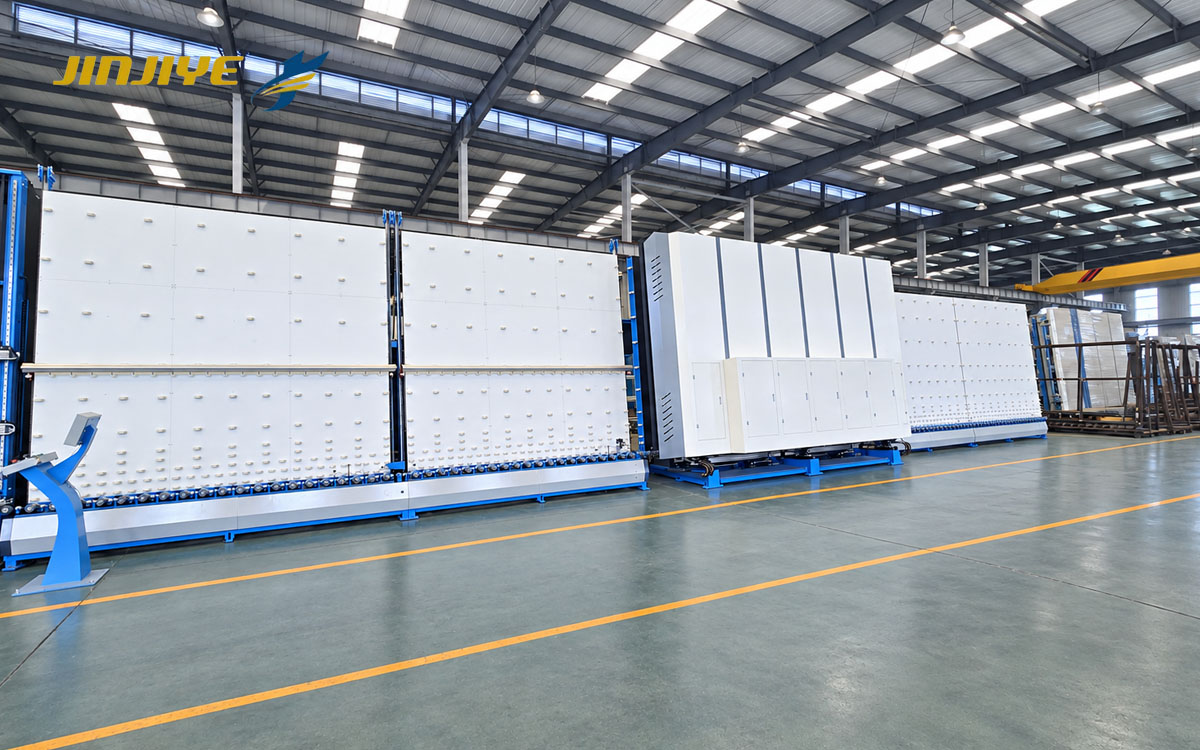
There is no universally better direction for an automatic IGU production line. A left-to-right line is correct when it follows the factory’s material flow; a right-to-left line is correct when the building, storage area and downstream equipment favour the opposite route. Before ordering, mark where raw glass enters, where spacer frames are prepared, where completed units go for secondary sealing and how people and forklifts move. The best direction is the one that avoids unnecessary turning, backtracking and route crossings.
Why Working Direction Is More Than a Machine Option
Working direction describes the route taken by the glass through the production line. Viewed from the operator side, the glass may enter at the left and leave at the right, or travel in the opposite direction.
On a drawing, reversing the line may look like a minor change. On the factory floor, it affects loading, spacer-frame delivery, inspection, unloading, secondary sealing and finished-unit storage.
A poorly chosen direction may still allow the machine to operate, but workers can spend every shift moving racks around the line or carrying materials across a busy route. That lost movement does not appear in the machine’s advertised processing speed.
Factories comparing configurations can begin with the JINJIYE insulating glass production line range, then evaluate the complete route surrounding the equipment.
Map the Glass Journey Before Choosing a Direction
Start with an empty workshop drawing. Add the building columns, doors, walls, electrical cabinets, drains and any machines that will remain in place. Next, draw the actual product journey:
Raw glass storage or cutting area
Loading position
Washing and inspection
Spacer positioning and assembly
Pressing and optional gas filling
Secondary sealing
Finished-IGU rack or dispatch area
Do not draw only the main line. Include the space used while changing glass racks, delivering spacer frames, removing rejected panes and carrying out maintenance.
The line should normally help material move forward. If finished IGUs must return past the loading area to reach the sealing station, the route deserves another look. The same applies when incoming glass racks and outgoing finished units compete for one doorway.
Left-to-Right or Right-to-Left: What Should Decide?
Do not choose a left-to-right IGU line simply because it appears more common in a supplier’s photographs. Use the conditions in your own factory.
Begin With the Raw-Glass Side
Check where glass arrives from cutting or storage. The loading end should be convenient for the racks used in daily production, not only for the demonstration rack shown on a layout.
Consider how a full rack approaches, where the empty rack waits and whether the operator has a clear view while loading. A shorter route can reduce handling, but it must still leave suitable working and access space.
Look Beyond the End of the Main Line
Pressed IGUs are not necessarily finished products. They may still need secondary sealing, inspection, temporary storage or packing.
Place these downstream operations on the layout before selecting the working direction. If a sealing robot or manual sealing station will be installed later, reserve a practical transfer route now. Otherwise, a line that looks well positioned today may face the wrong way after the factory is upgraded.
Bring Spacer Frames to the Correct Side
The spacer-preparation area should connect naturally with the frame-positioning station. Operators may need to bring frames from a bending machine, desiccant filler, butyl extruder or spacer rack.
Watch for a layout that forces these frames across the glass-loading route. Spacer frames are light, but repeated crossing wastes time and increases the chance of mixing orders or damaging prepared frames.
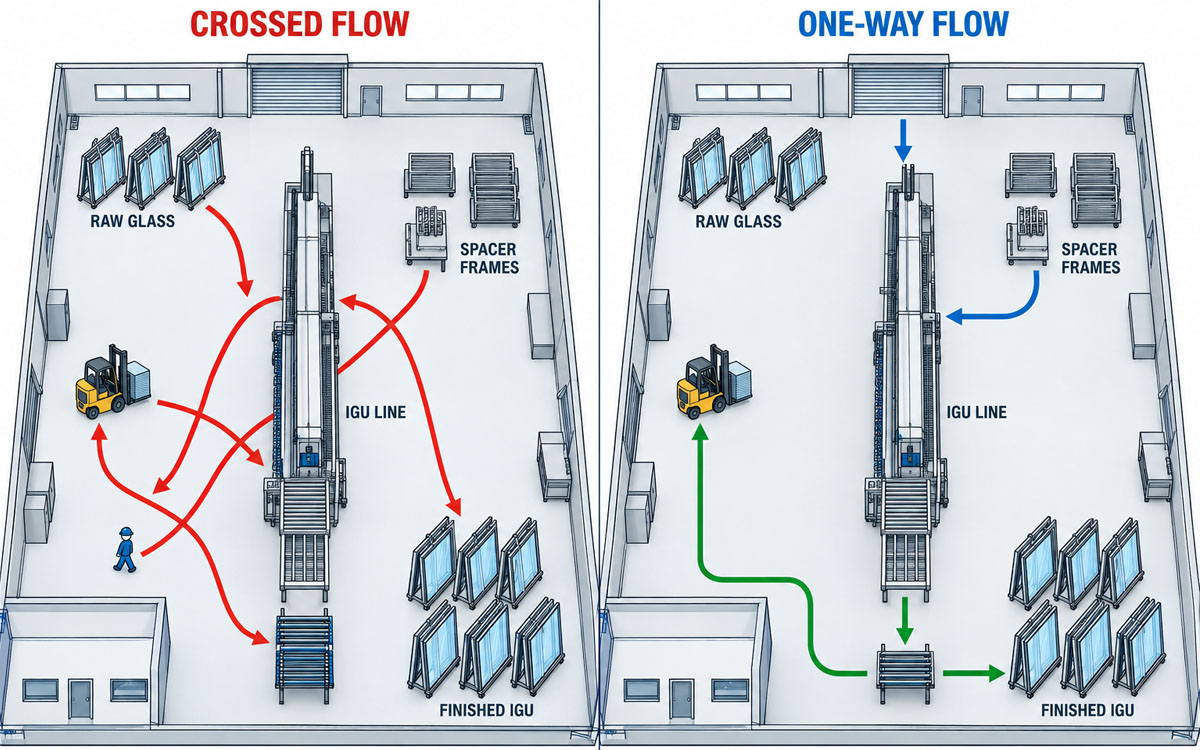
Separate Production Flow From Traffic Flow
A good production route should not create a bad traffic route.
Mark pedestrian paths, forklift movement, material-delivery points and emergency access separately. Pay particular attention to blind corners and locations where a rack or large IGU may restrict visibility.
OSHA guidance requires appropriate clearance and unobstructed aisles where mechanical handling equipment is used. HSE guidance also recommends mapping pedestrian and vehicle movement and separating them where reasonably possible. The applicable rules and required clearances must be checked for the country and factory involved.
Choosing the line direction will not solve every safety issue, but it can prevent a predictable conflict from being built into the layout.
Leave Room for Operation and Maintenance
A layout is incomplete if it shows only the equipment outline.
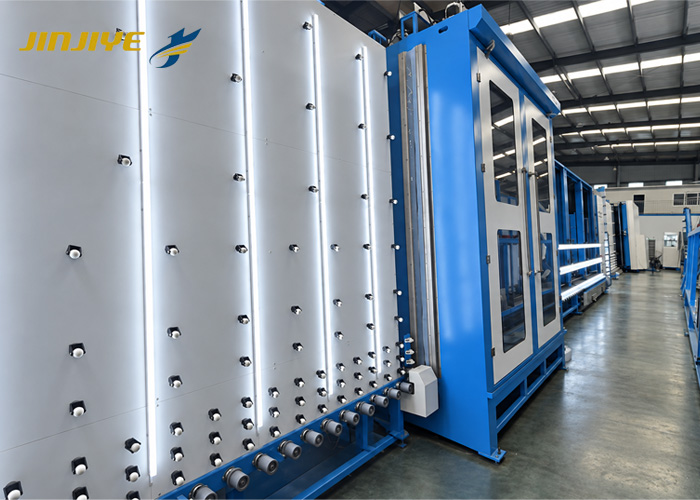
Ask the supplier to identify operator positions, control cabinets, doors or covers that require opening, normal cleaning points and areas used to remove or replace service components. Confirm that columns, walls, other machines and stored glass will not obstruct the required access.
Utilities should also be checked before the layout is approved. The final locations of electrical connections, compressed-air supply, washing-water equipment and drainage depend on the ordered configuration and site conditions.
The automatic CNC gas-filling IGU line, for example, lists left-to-right or right-to-left line direction as an ordering option. Buyers should still confirm the approved layout, machine configuration and connection points before production begins.
Test the Layout With a Real Order
Before signing off the drawing, choose a normal customer order and walk it through the proposed factory.
Ask:
How does the first pane reach the loading end?
Where is its matching pane?
How does the correct spacer frame reach the assembly position?
Where does the pressed unit wait?
How does it reach secondary sealing?
Where are rejected or reworked units placed?
Can a forklift complete its route without entering the operator’s work area?
What happens when one rack is full and another must be exchanged?
Repeat the exercise with one large unit and one small mixed-size order. A layout that works only with a single convenient glass size is not yet proven.
Plan for the Next Machine, Not Just This One
If the factory may later add automatic sealing, gas filling, additional spacer equipment or a larger storage area, show the possible expansion on the current drawing.
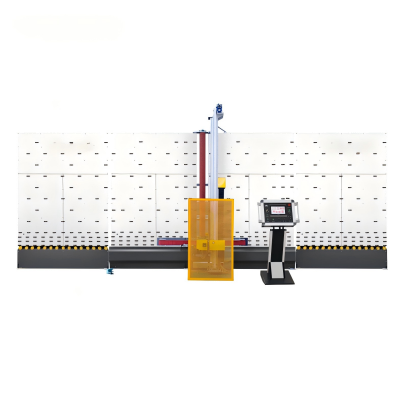
This does not mean buying every machine now. It means avoiding a direction that blocks the most likely upgrade route. The fully automatic vertical IGU production line can be reviewed as one possible production configuration, but the final direction and surrounding arrangement must match the buyer’s building and process.
Final Decision
Choose the IGU production line working direction only after the full material route has been drawn and checked. Start with raw glass, follow the product through spacer preparation and assembly, and finish at sealing and storage. Then add people, forklifts, maintenance access and possible future equipment.
Send the supplier a dimensioned workshop drawing rather than describing the factory as “large enough.” Mark doors, columns, existing machinery, storage zones and the preferred material route. This gives both sides something concrete to review before the equipment is manufactured.
Frequently Asked Questions
Is a left-to-right IGU production line better?
No. It is better only when that direction suits the factory’s glass entry point, downstream equipment and traffic pattern. A right-to-left line may be more practical in a mirrored workshop.
Can the production-line direction be changed after installation?
It should not be assumed. Reversing the process may require a different machine arrangement, controls or component configuration. Confirm the direction with the manufacturer before the order is finalized.
Should the sealing machine be included in the layout?
Yes. Even when it is purchased separately or added later, its likely position affects the exit route of the main IGU line.
What drawing should I send before requesting a quotation?
Send a dimensioned floor plan showing doors, columns, walls, existing machines, glass-storage areas and available utilities. Add the routes used by raw glass, spacer frames, finished units, operators and forklifts.
Can JINJIYE review our proposed working direction?
Send JINJIYE your workshop drawing, production requirements, glass range and existing-equipment positions. The proposed line direction and configuration can then be discussed before the final equipment layout is approved.